
Grief, but Make It Fashion
.png)
The American Girl fashion show fundraiser for Duke Children’s Hospital & Health Center in spring of 1998 was the first time I wore real makeup. At nearly 10, I remember my mom buying me a rose pink CoverGirl lipstick at the drugstore, which twisted up and out of its mauve tube smooth as a cube of ice. I held onto my first lipstick until at least high school, crusty remnants of color along its edge.
Many months before the show, my mom had entered me in a local contest, for which I auditioned to be selected as a live-action American Girl. Although I auditioned for the role of Kirsten Larson, who journeyed from Sweden to Minnesota in the late 1850s, the judges selected me to model as Felicity Merriman, described on the American Girl website as a “spirited girl from 1774 Williamsburg.” I accepted the role.
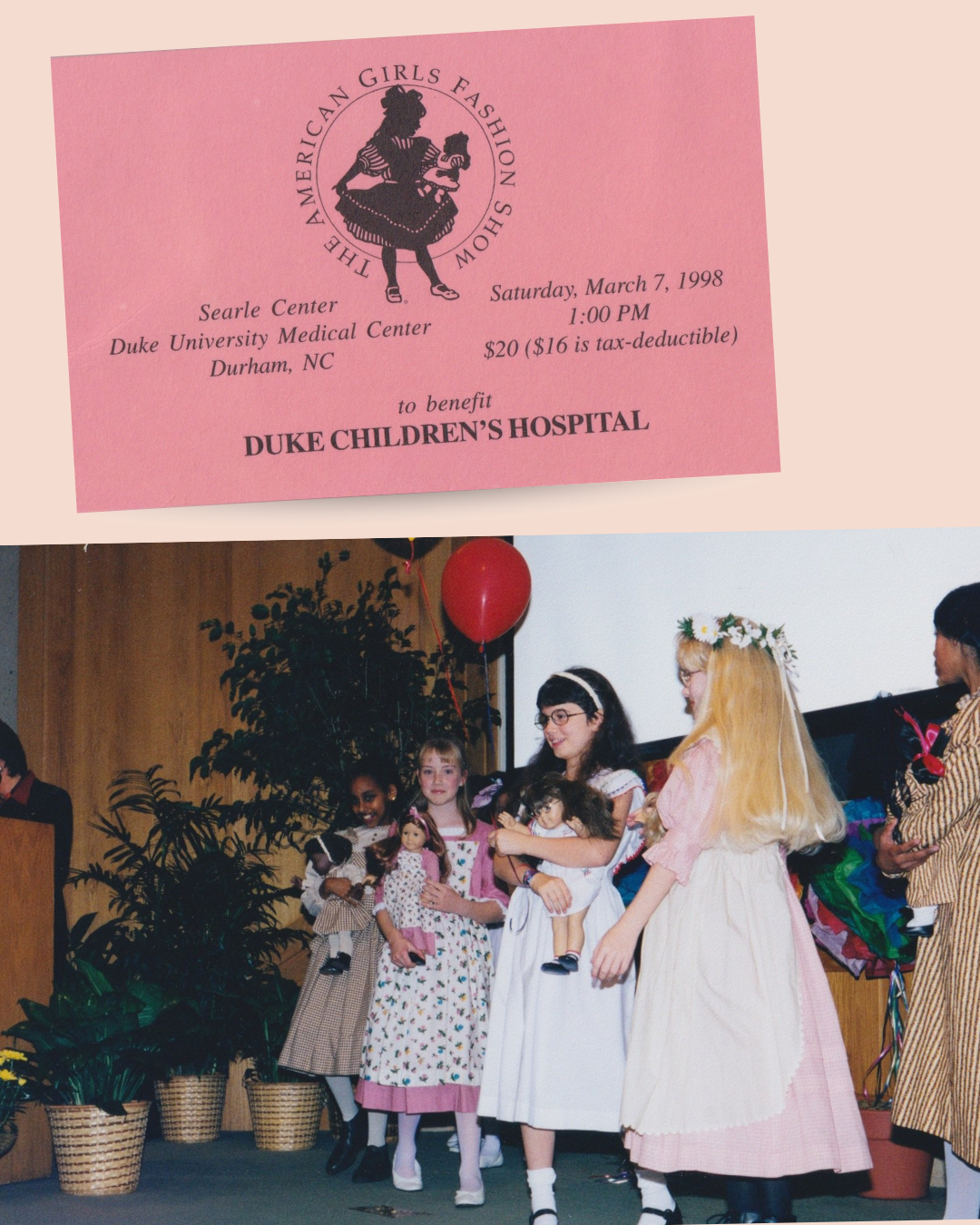
As a child of the late 1980s, I was most familiar with Kirsten’s story; I had read her anthology cover to cover many times, and she was my only doll. My younger sister had Samantha Parkington, the coveted Edwardian-era beauty with the enviable scarlet bow. Samantha was, without a doubt, far more posh than my doll’s looped braids tied in ribbon. But out of 500 girls who auditioned that day for six coveted slots (of note, this was Josephina Montoya’s debut year) the judges saw the strawberry blonde in my hair — and likely knew that it wasn’t long enough to be braided into loops — and christened me Felicity.
In 2025, our then eight-year-old daughter discovered the American Girl series at our local library, and we checked out Kirsten’s story. She read the first several chapters so quickly, that as a third grader, I wondered how much of it she truly understood. Kirsten’s best friend, Marta, dies suddenly aboard a riverboat from cholera at the close of chapter four, following many vignettes of a fictional and fun girlhood in the 1850s.
“MOM,” I heard coming from her bedroom, moments before bedtime.
“MOM. MARTA DIES?”
Yes, sweet child, Marta dies.
She buried her head under her covers and kicked her legs as she could not bear the grief that had assaulted her with such force.
After the fashion show — where we glided our way through the audience, showcasing our American Girl garb while holding our matching dolls at every stage of their story experience — I felt affronted that we did not receive our own American Girl doll. Surely, they owed me that in exchange for my services.
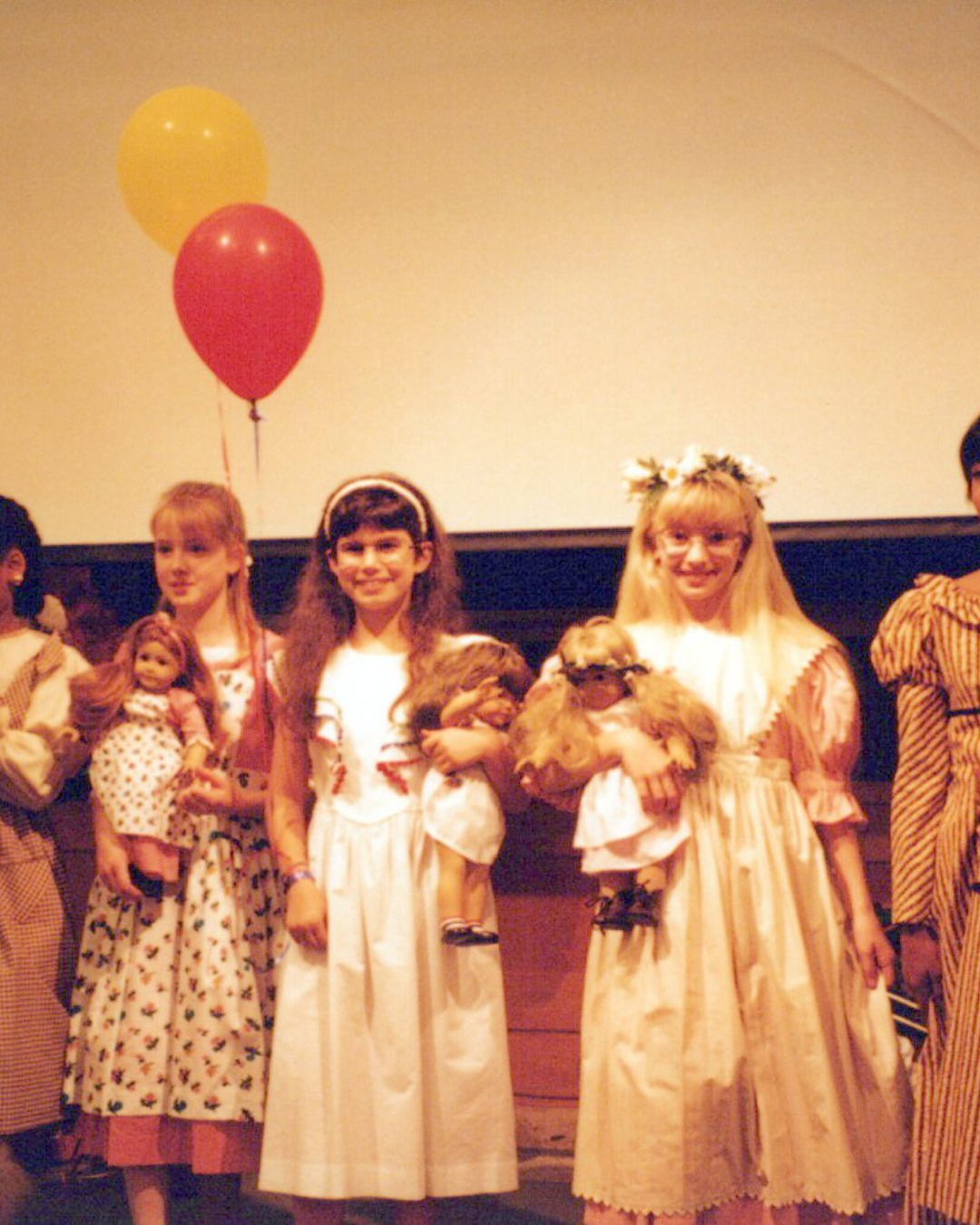
Six weeks ago, I was at my parents’ home in North Raleigh cleaning out my childhood closet. It was a slow process, raking through stacks of letters from high school, elementary school art projects, and rumpled clothes. I stumbled upon a photo of me as Miss Merriman, my hand aloft and waving to the crowd, a smile on my face, lips coated in CoverGirl. The single photo was the only evidence I had of my time of my brief career as a fashion model. In it, a pink dress and white floral apron adorned my body, and the doll (only on loan for the show) rested on my hip. I also found the corresponding program, detailing each of the models, our respective dolls, and information on the fundraiser for Duke. I quickly scanned the roster — I knew that girl from college at Carolina, another from childhood, and I saw one name I had recently connected with: Becki Feinglos, at the time, apparently the incarnate of Molly McIntire.
Thanks to the internet and grief communities, I had been added to a text thread several months prior — we call it the Dead Parents Club — with several folks I had never met. I had shot a text to strangers: “Y’all NEED to listen to this podcast,” only to receive a text back moments later: “Um, hi, that’s my podcast.” I was both mortified and elated that I had connected with THE Becki Feinglos, whose podcast I had recently binged.
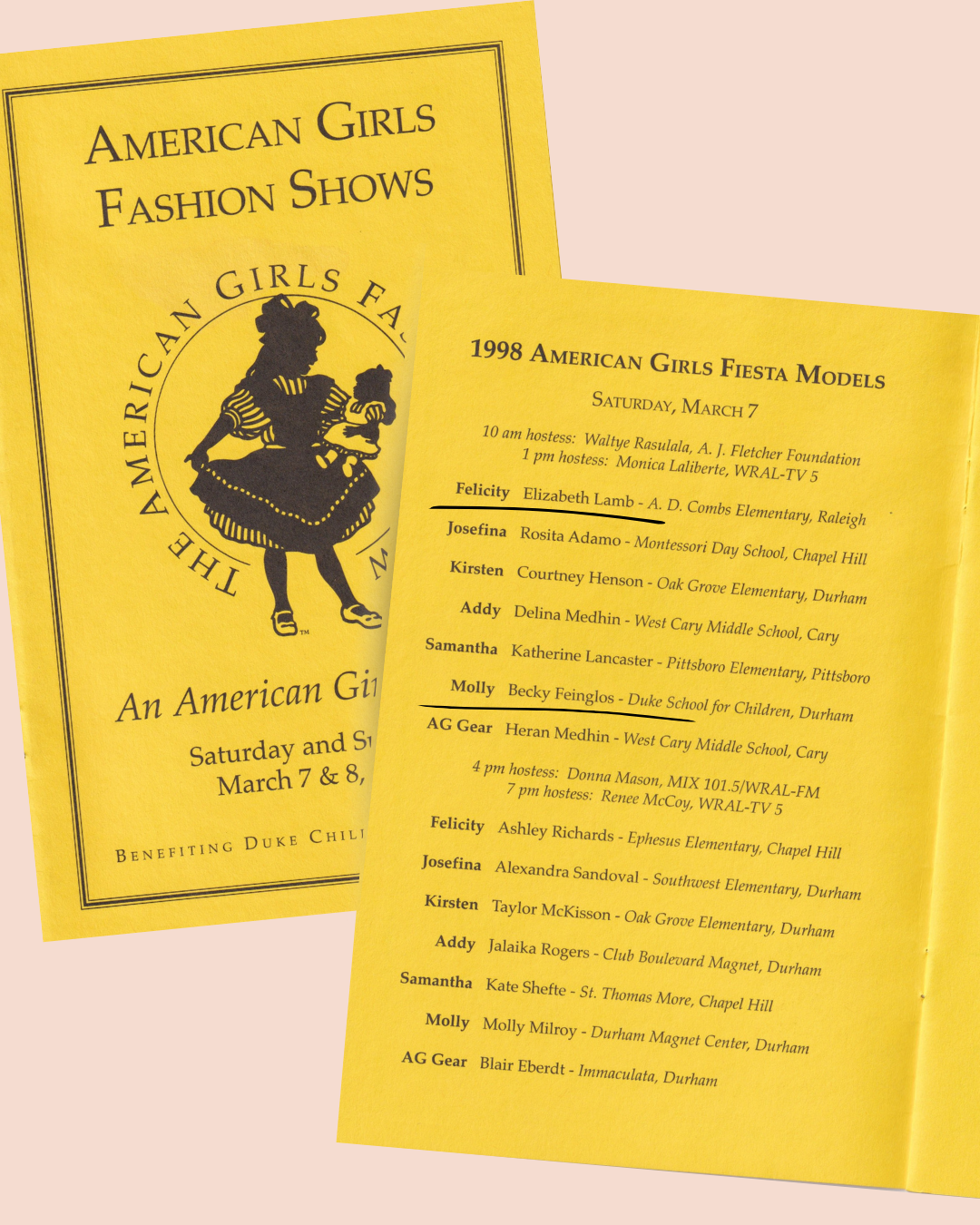
Both of us — call it fate, random chance, whatever — had mothers (named Susan, of course), who died of glioblastoma multiforme 14 years apart. Both had cutting-edge, research-driven treatment at Duke, where they tell you hope will get you through. Becki’s mother died when she was a child; I was pregnant with my oldest daughter when we found out our mom was sick after she had a massive stroke that nearly killed her.
She died in 2017 at 58 when my daughter was five months old. I did weekly therapy for a year and learned about anticipatory grief. Becki and I have both participated in the Angels Among Us 5K over the years, another Duke fundraiser fighting the rare disease that took our Susans. Turns out, we had met once nearly 30 years ago, when our mothers were in the audience at the fashion show: one sick, the other healthy, one unable to help her daughter backstage from illness and the other buying her daughter CoverGirl lipstick for the first time, backstage with me, showing me how to apply it properly. I immediately texted Becki.
“Hello from your random internet friend,” I began. “I was going through my parents’ house bc dead and aging parents and found this. I was Felicity — Elizabeth Lamb.”
“IM SORRY ARE YOU F****** KIDDING ME,” she texted back. I am left wondering if the Susans are co-conspirators wherever they are now.
My dad, who is in his late 60s, has developed Parkinson’s, and we recently moved him to independent living, hence my closet-cleaning adventure. During our text exchange, Becki sent me a link to grainy video footage of the entire fashion show. I sat on the couch gobsmacked, staring at my phone, watching myself strut among the aisles of prospective donors. I had forgotten that my dad had delivered opening remarks.
“I’m happy to welcome you to the fourth annual American Girl fashion show,” my dad begins, in a steady voice I haven’t heard in years; Parkinson’s has softened it. “My daughter, Elizabeth, will be modeling today as Felicity. My wife, Susan, and I are very proud of her and are very pleased that she can participate in this benefit.”
He goes on to share a bit about my younger sister, who had life-saving surgery as an infant at Duke to repair a congenital heart defect. They later used her case as the ‘model patient’ (albeit not Felicity, Samantha, or Kirsten) around the world. I know my parents privately and sometimes publicly dealt with the grief of a child born with tetralogy of fallot; they did not know she had a hole in her heart until moments after her birth.
After I caught my breath, I resumed play. Moments later in the footage, my sister, age six (who is now a happy and healthy adult, living in North Carolina) plucks a raffle ticket out of a hat; she is designated as the raffle-ticket-picker-outer and assumes her duties at various intervals throughout the show. I am further struck, later on in my review of the video, by the backs of some heads that I think I recognize. Oh, that’s my grandmother, our mother’s mother, my sister crawling back into her lap after each raffle prize winner is selected. Our grandmother died in 2023 in her nineties, several years after our mother. We would share a bittersweet six years of getting to know our mother through her mother’s eyes, and after she had lost her child. Becki and I share in the grief that we have each lost our mothers but had their mothers around for a while longer.
I also spotted our grandfather, aunts, cousins, but I could not find our mom, despite scrubbing through the video both slow mo and warp speed. I figured she must have been backstage, embodying the stage mom as best as she could. Finally, I feel a crush of relief after I spot our mom after the show concludes, over an hour into my rewatch. She lingers in the corner of my phone among colorful tissue paper floral arrangements and the waitstaff clearing tables.
Grief comes in many forms and at many times. When this happens — when our children ask about Grandma Susan’s brain that had cancer, muse about never having really met her, or I feel angered that they’ll never know their grandmother in the ways that I knew mine, when I feel my face and eyes get hot and start to sting, vision blurred by a sudden cascade, I think about what she would have not wanted me or those whom she loved to do. She would not have wanted us to wallow in sadness. She would not want a crippling grief to steal my ability to be present with our daughters. I have tried to explain brain cancer in the best ways I know how with age-appropriate language, titrating more of the full story as they get older. And she would not want us to ever stop loving our families well. After all, Kirsten’s ‘Papa’ always said to never lose heart.


.png)
.png)
.png)