
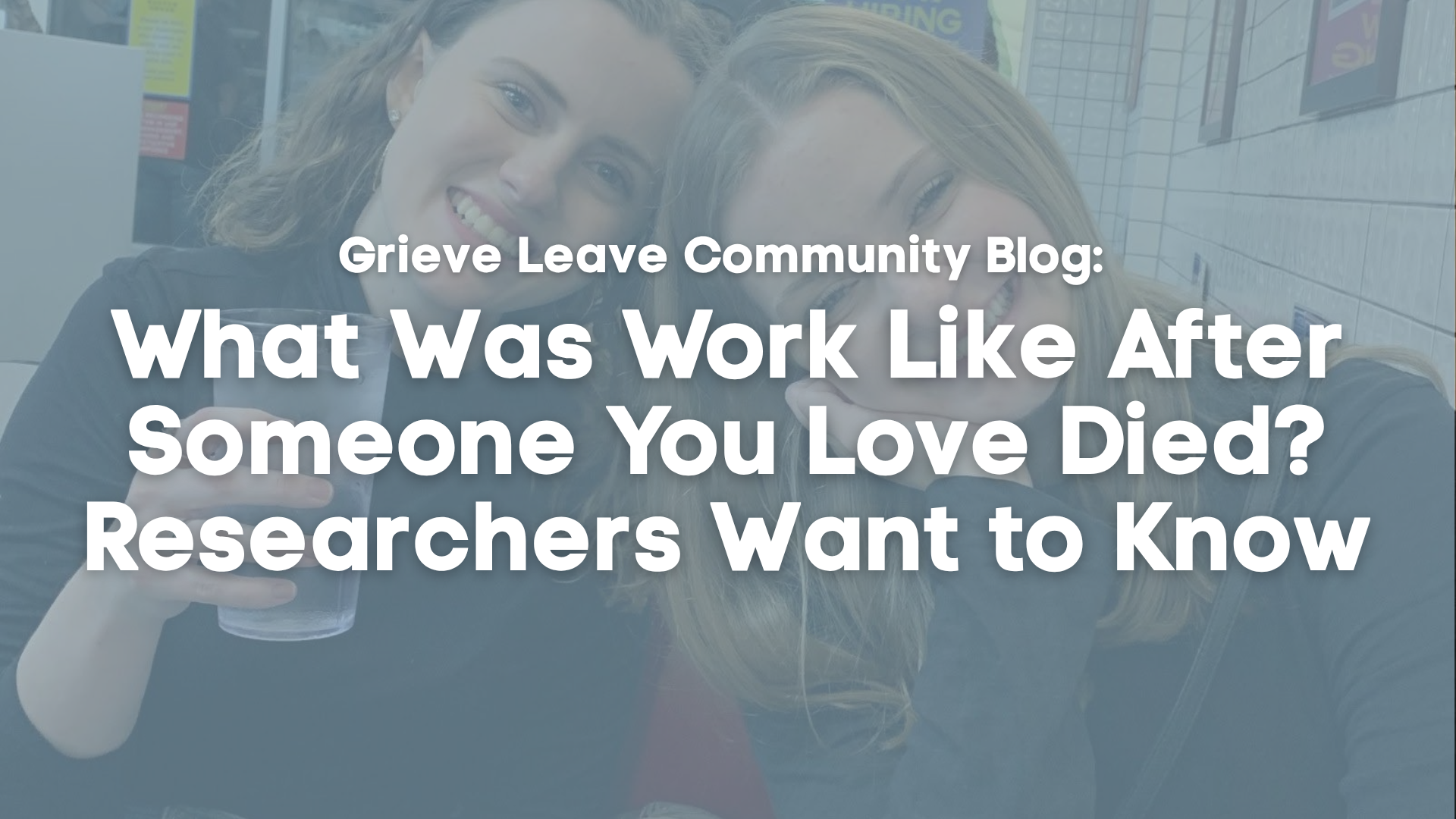
What Was Work Like After Someone You Love Died? Researchers Want to Know
My name is Katherine Facteau, and I am a PhD student studying Industrial-Organizational Psychology at the University of Georgia. I am currently conducting research for my dissertation on employees’ experiences of grief at work, and I am seeking participants. Before I tell you about my study though, I’d like to talk about my personal grief experience that inspired this research.
.jpg)
My journey with grief began about three years ago when my best friend and PhD cohort-mate, Beth Buchanan, was killed by a drunk driver. She was only 23 years old. Beth was driving her mom to the Atlanta airport after a mother-daughter weekend in Athens, GA. The driver was drunk on the night of the Super Bowl and was driving on the wrong side of the highway with only one working headlight. His blood alcohol content was three times the legal limit. Beth’s mother sustained severe injuries and was in the hospital for months, but she has now recovered. On top of this tragedy, the drunk driver was not detained by police and later fled the country. He has yet to be found. This past February, there was a civil case in Athens, GA, against the driver, and Beth’s family was awarded $50 million in damages (mostly symbolic, as they likely won’t actually see this money).
I could write paragraphs about the amazing woman and friend Beth was. She was a second-year PhD student studying important topics related to employee well-being, lower-income workers, infertility and its impact on working women, and work-life balance. She was brilliant—valedictorian of her high school (which none of us even knew until she passed), the recipient of numerous awards from her alma mater, Rice University, and just beginning her Master’s thesis research. There are now several scholarships and foundations honoring her passions for research and service.
.jpg)
Beyond her brilliance, Beth was a kind, joyful, and caring person. I still hear her laugh in my mind when I think about the many jokes we shared. I have never connected with a friend the way I did with Beth. My grief has taken many forms over these three years, but right now, I think I feel it most acutely in the injustice that I no longer have my best friend to go through life with. I have several close friends, but I often find myself thinking that it’s so unfair that I lost the one person who really “got me,” and I her. There have been so many times I’ve seen best friends together, or wanted to share something only she would understand, only to feel angry that her life, and our life together, was taken in this way. My grief has been for her, but also so intensely for the life I know we would have had together.
Right now, she would be finishing her PhD, and we would be walking across the stage together at graduation this fall. She would have done her dissertation on something impactful, like how to help workers our research often overlooks. She wanted to be a professor, and I smile thinking about what a great mentor she would have been to her students.
This all happened during my second year as a PhD student. I was unable to function for several months, if not a year, after her loss, especially because her absence was felt so strongly in classes, research meetings, and program events. I am now in my final semester of the program and planning to graduate this fall, after which I will begin a career with Ernst & Young as a Behavioral Science Specialist.
.jpg)
The final stage of our PhD program is conducting our own research for a dissertation. In the past, I likely would have studied something like workplace mentoring, work-life balance, or employee engagement. However, losing Beth changed me and changed what I see as important in life. For these reasons, my dissertation focuses on employees’ experiences at work after a loved one dies. This stems from the many conversations I had with Beth’s family and friends about how varied their workplace experiences were after loss—some felt supported, while for others, work was an extreme burden. Bereavement leave in the United States is typically very limited, leaving many people who are grieving to return to work quickly with little support. My goal with this study is to better understand how employees navigate loss and how workplace experiences can positively contribute to bereaved employees’ well-being.
If this is something you are interested in, I am still actively recruiting participants who may want to share their experiences with me. I am looking for people who are employed full-time and have experienced death-related grief in the past year. Participation involves one short eligibility screener (about 5 minutes), and if you meet our criteria, two 20-minute online surveys approximately three weeks apart. You will receive a $10 gift card if you complete both surveys.
.png)
Participation is completely optional. If you’re interested in sharing your experience, you can start with the short eligibility screener below. You may pause the survey at any time or stop participating at any point.
https://uga.questionpro.com/griefworkstudy3
Our study has obtained IRB approval from the University of Georgia.
Thank you for reading and considering participating!
Katherine Facteau


.png)
.png)
.png)